Wednesday, November 15, 2023

The Battle of Helm's Deep - Midgard AAR

My second game of the weekend was a scenario based on the Battle of Helm's Deep (the book version, so Haldir and his pals weren't in attendance). 


Chris, who was running the game, created an impressive model of Helm's Deep. 


The Hornburg was incredible, a massive structure of modeled mountain and 3d printed castle walls. 


From atop the highest rampart, Théoden watched over the assembling army of Isengard, a mix of fearsome Uruk-Hai, Orcs, Goblins, Trolls, and Men of Dunland. 


More warriors of Rohan lined the defenses of the Deeping Wall. 

Prior to the start of the game, both sides (I was commanding half of the Rohirrim) made some pre-battle choices. For the defenders, we decided to send Éomer out on a mounted sortie with a unit of elite warriors to hopefully peel of some of the attacking forces. The attackers brought a couple siege towers, a Fire of Orthanc hidden somewhere in their units, and some other choices that we would find out about later in the fight. 

The attackers also had a pair of camps that defeated units would respawn from, representing the unending hordes of Isengard's army.

The game would last six turns, with the defenders rolling randomly at the start of turn four to see if Gandalf would arrive with Erkenbrand and his surviving warriors. 


The horde of Isengard advanced at a steady clip, with some desultory archery fire from the defenders.


A smaller force of Uruk-Hai split off from the main group, marching up the earthen ramp to the Hornburg. 

It wasn't until the orcs were committed that they realized no one had thought to bring the battering ram!


Éomer and his men launched their attack on turn two, drawing off three Isengard units. The warriors of Rohan defending that section of the wall were relieved that combat wouldn't reach them so soon. 


Despite this, the main Isengard attack quickly broke through the Deeping Wall, with a unit of goblins sneaking a Fire of Orthanc into the Deeping Wall's culvert. Legolas spotted the goblins carrying the bomb too late and it exploded, killing the goblins and damaging the Rohirrim units defending that section of the wall (luckily Aragorn, who was on top of the Culvert when it blew up, was unharmed). 


Using their siege towers, the forces of Isengard quickly took the top of the wall, scattering the damaged Rohan Archers. 


It was a fierce battle atop the Deeping Wall, with Aragorn leading an attacking to try and reclaim the lost section that flanked Legolas and his unit. 

In the distance you can see Éomer fending off a couple Isengard units by himself, after his accompanying unit was wiped out. 


Meanwhile the Uruk-Hai steadily advanced up the rampart to the Hornburg. 


The defending Rohirrim were being pushed back, with another unit of archers routed. Isengard units were beginning to pour through the hole in the wall. Sadly, Legolas was the first hero to fall, assisting an elite unit of warriors hold back a force four times their size of Orcs and Dunlendings. 


Hoping to score some some morale points on my side, I had Háma charge out the gate with the Kingsguard. 


My luck had apparently be used up in the previous game that morning, and the Kingsguard were pushed back towards the gate. 


Then we discovered that the forces of Isengard had sent a unit of scouts to scale the walls of the Hornburg, resulting in a flank attack!


The forces of Isengard were in solid control of half of the Deeping Wall, resulting in an ongoing morale loss to the defenders. 


And another unit of Orcs appeared in the rear of the defenders, as more orcs mounted the wall.


Sadly, Gimli was the second hero to fall, helping to fell a unit of trolls (in another universe, Gotrek Gurnisson would likely find that a good death). 

I had Aragorn join up with the surviving unit of elite infantry and make their way to support the remaining Rohirrim units. The Deeping Wall might be lost, but perhaps the surviving warriors would push towards the Hornburg...


It was in turn six that Gandalf, Erkenbrand, and the rest of the relief cavalry arrived, too late to do much else apart from destroy an Isengard camp. 


The Hornburg was still somewhat secure, with the ambushed warriors of Rohan turning to face their attackers. 


However, the mess behind the Deeping Wall was too much for the defenders to handle and their morale was broken, giving Isengard a solid victory and potentially changing the fate of Middle Earth forever!

This was a wonderfully thematic and fun game to play. Had I another chance at it, I would definitely need to make some different choices, like getting the units and Théoden in the Hornburg down into the fray of the Deeping Wall. Abandoning the Wall might also be a good idea, instead of allowing the Fire of Orthanc to deal damage to units that hadn't seen combat yet. And I definitely feel like I didn't take Chris' advice of using the heroes enough, as they felt underwhelming against the massive Isengard force.

Still, Chris did a great job of adapting these set of rules to a siege battle, and it's still visually stunning. I will definitely pick up a copy of Midgard once it's released, as it might be a good way to utilize the 3mm fantasy figures I purchased a bit ago. Overall, it was a good conclusion to my first day at Fall In. 

Wednesday, November 8, 2023

Dawn Burns over Tennessee - All Quiet on the Martian Front AAR

Autumn has arrived and Halloween has passed, which means it's time for Fall In!

I signed up for four games over Friday and Saturday, and picked up a few items here and there from the exhibitor hall. 


My first game of the convention was a personal favorite: All Quiet on the Martian Front!

Set up as a "classic" brawl between Americans and Martians that would have been typical during the Second Martian Invasion, both sides consisted of relatively straightforward forces. 

The Martians had three Assault Tripods (one armed with Black Dust, another with Green Gas) and six Scout Tripods. 

The Americans had a reinforced infantry company (with three infantry squads and a machine gun squad per platoon), two platoons of Mk. III Steamers, three platoons of Mk. II Steamers, and a platoon of Steamer Artillery. 

The American infantry was deployed hidden, scattered across the battlefield, with some false "blips" thrown in to keep the Martians guessing.

The game would last six turns, with both sides attempting to break the other (I believe the Martians needed to lose 9 units, while the Americans needed to lose 15). 


As the attackers, the Martians came surging forward, revealing infantry and MG pickets hidden in the woods and buildings. 


Another MG squad was revealed by the Scout tripods. 


The Martian advanced was checked by concentrated steamer firepower, combining the mobile artillery's barrage and the steamers' 4" guns. Scratch one tripod!


One the flank in front of me, the Martians were using the move-fight-move turn order to sweep in, burn out the infantry with their lasers, and then fall back outside of the infantry's range. 

I did forget that the MG's had a 20" instead of 15" like the infantry squads, so I lost two MGs before I was able to fire with them. 


The second Assault tripod went down to the massed 4" guns of the Americans...


As did a Scout tripod on my flank...


And another Scout was taken out! Along with a squad on infantry, but that's a pretty worthwhile trade. 


Confident with their hot dice and the sudden lack of tripods in front of them, the Americans began to advance and press their advantage. 

Two squads of Rough Riders also managed to entangle the single remaining Assault tripod with their tow cables, before speeding off to try and avoid the patrolling Scouts.


Of course, that put the American tanks in the perfect position to be ambushed! Two steamer tanks were destroyed.


The Rough Riders were also slain, with their retreat suddenly cut off by Martian reinforcements.  


My platoon of Mk. III Steamers, which I hadn't been able to get into the fight, were routed and wiped out by the new Assault tripod. 


The American advanced was suddenly checked, with three rampaging tripods in their flank. 


I pulled my steamers back, concentrating fire on the Assault tripod. I managed to damage it's armor, but the Martian war machine kept coming. 


In the center and on the American right, the humans were able to better maintain their lines. 


American infantry attempted to launch assaults against one of the Scout tripods with their Forlorn Hope squads, but the explosive packages turn out to be duds, and the infantry were forced to retreat back to their cover. 


The Assault tripod was felled, but at the cost of one of the American command steamers and 2/3rds of a Mk. II platoon. 


A second infantry assault against a Scout tripod was launched...


With much better results!


The other Mk. III platoon was having much better luck, destroying a Scout platoon in the last turn of the game. 

And here's the table at the end! You can see that the American left flank (my command) had pretty much collapsed, and I had another steamer platoon were routing. However, the Americans had a good command of the center and their right flank. 

Having lost most of their attacking force, the Martians were forced to retreat. The Americans had suffered quite a lot in return, but were in overall better shape. 

This was a fun game overall, and a great start to the weekend!

Wednesday, October 4, 2023

So Long, Solachon! - So Convenient for Hewing AAR

Barrage 2023 was a couple weekends ago, and I haven't had a chance to attend since 2019. While I wasn't able to take off from work to attend Friday, I signed up for a couple games on Saturday. 


My first game was a playtest/demonstration of the "big battle version" of a ruleset, "So Convenient for Hewing", run by the author himself. 

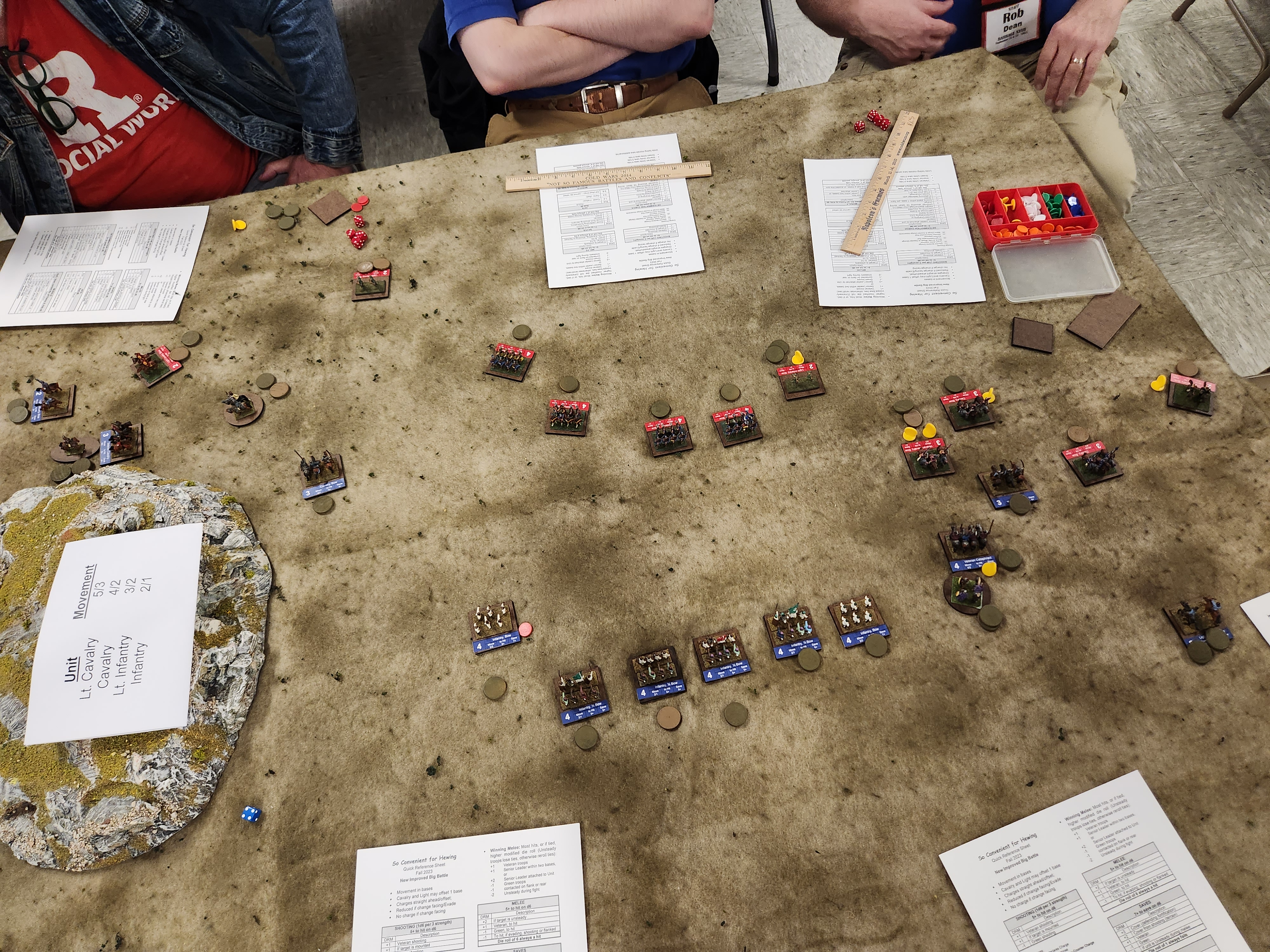
The scenario was based on the Battle of Solachon, between the Byzantines and Sassanid Persians. I played the scenario with a team of father-and-sons (Rob, Norman, and Will if I remember correctly) from the HAWKS group. Will and I played as the Sassanids, while Rob and Norman commanded the Byzantines. 


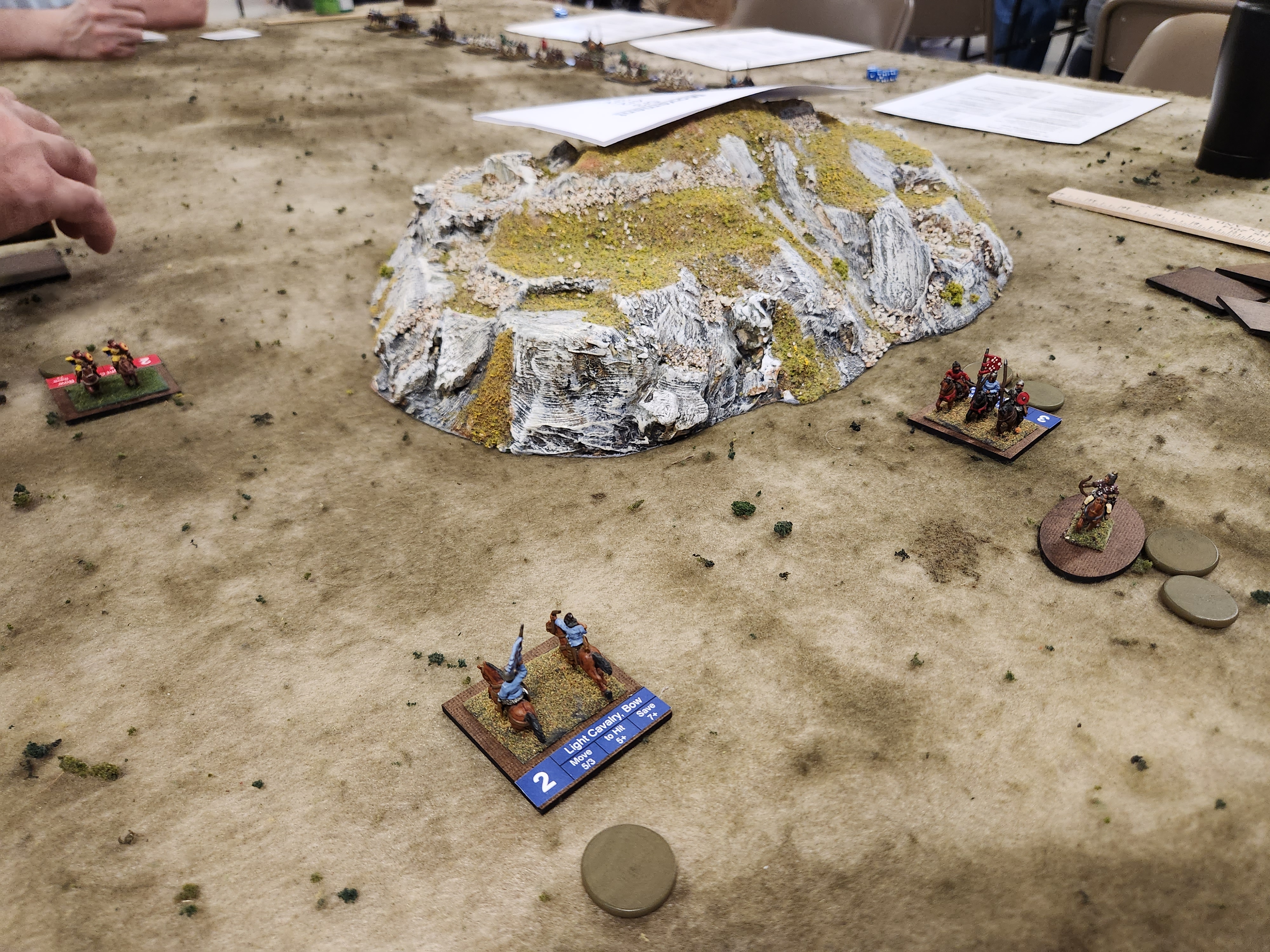
The game started with the reveal of a Sassanid cavalry ambush, hidden behind the rise dominating one side of the battlefield. 

I should talk about the rules a bit. Turns are split into actions determined by random card draws between a Red side and a Blue side. Each card has an Action (Move, Shoot, Charge, Free) and a couple End Turn cards. Units alternate performing that action between sides. The card's corresponding color has initiative for the Action. For example, a Red Charge card will allow the Red side to make the first charge.

Units also have action pips (1 or 2), which they can spend to take the action on the card. Once a unit is out of pips, they can no longer take actions.

So a unit could potentially charge twice in a turn, or move twice, or shoot twice. But it's random, and spending your pips early in a turn can leave you without any chance to exploit a situation later in the turn. But those two End of Turn cards can be drawn at any time, leaving your saved pips wasted. 


Will took command of the ambush and the Sassanid left, facing off against Norman. 


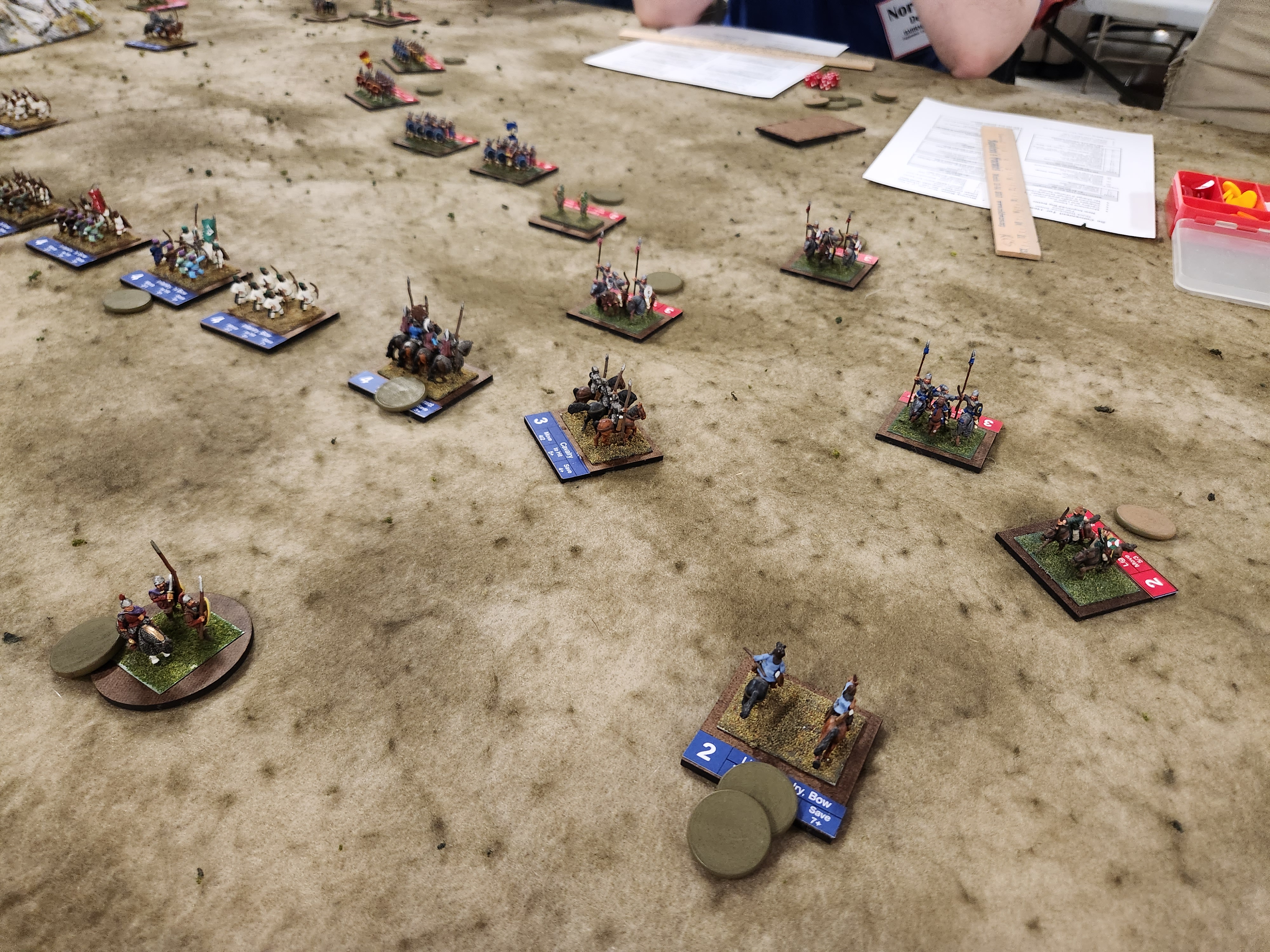
On the other side of the battlefield, Rob and I performed a cavalry ballet. 

And the footslogging infantry worked their way towards combat. 


The Sassanids had a unit of Cataphracts, which were the kings of the battlefield. But my poor luck meant they weren't all that effective. However, my light cavalry kept two of Rob's cavalry units occupied. 

After a few turns, the Sassanid ambush had succeeded, leaving the Byzantine's flank wide open. 

It was also here that we discovered the rules' "end of game" mechanic; for every regular (non-light) unit lost, you compare that number to a d6 rolled at the end of each turn. If you roll equal to or under that number, your army routs!


While the light cavalry occupied each other's attention, Will pushed into the Byzantine flank. Will's infantry fell back, peppering the Sassanid cavalry with arrows. 


The cavalry battle on the Byzantine left wasn't as decisive. 

I should note that the Sassanids had one huge advantage in this game; a second general. Generals in these rules can use their pips to command other units and can join units for extra bonuses. With the right combination of cards, a general can get a unit of veteran cavalry to charge four times in one turn! 

With two generals commanding their cavalry, the Sassanids had a decent advantage in decisive activations. 


Of course, that didn't matter so much when I couldn't get my troops in order (i.e., not roll like crap). With my light cavalry chased off my flank, Robt was free to swing his own light cavalry into my exposed flank.


Which gave Rob the chance to charge into the flank of my Cataphracts and send them running!

Luckily the Cataphracts' heavy armor kept them from taking any permanent hits, but they were suddenly in front of the main Byzantine line, full of mixed melee/ranged infantry units that were plenty willing to take potshots at the Sassanid cavalry as they rode by in a blind panic. 


In his efforts to catch the Cataphracts, Rob did allow his line to become muddled.


Meanwhile, Norman had managed to rout another Byzantine unit. 

I also managed to rout a Byzantine unit (while losing one of my own), and Norman bagged another.

It was there that the Byzantines finally rolled low enough for their army to break, and the game ended.

The rules received pretty positive praise from the players. Jessee did a great job adapting a set of skirmish rules to something that has the feel of a larger battle, and there are plenty of decisions to be made during the game. Our only concerns were how strong generals were (having both extra activations and bonuses to melee and leadership) and the somewhat arbitrary roll for ending a game. 

I would recommend anyone looking for a fun set of fairly simple rules that don't need a large investment to get into to check these out once the full version has been released. 

Wednesday, August 23, 2023

All Systems Greene - Washington's Wars AAR

I not only attended this month's SJGA game, but also helped to run it. Major kudos to Ryan who not only also helped to run the game but painted 120+ miniatures in a short period of time, and to Sam for providing his collection for us to use as well. 


Sam had requested earlier in the year that we run a game using the rules "Washington's Wars", which were published back in 1993 - two years after I was born. 

The rules have a few scenarios in the back, one of which was Guilford Courthouse. Sam's collection has both Tarleton's Legions and Washington's Cavalry, and Sam had an ancestor in Washington's unit. So we decided to use that scenario for our game. 


The British players started at one end of the table, consisting of:

General Cornwallis
General O'Hara
Colonel Webster
von Bose Regiment
71st Foot
23rd Foot
33rd Foot
1st Battalion Guards
2nd Battalion Guards
Grenadiers
Light Infantry
Legion Cavalry
Jagers
Artillery (2 Light guns)

Their goal was to rout or capture three of the four Continental regiments. 


The American were deployed in three lines, spread out along the table length:

First Line
General Greene
1st North Carolina Militia
2nd North Carolina Militia
North Carolina Riflemen
Virginia Riflemen
Artillery (1 Light gun)
Second Line
1st Virginia State Militia
2nd Virginia State Militia
Third Line
1st Maryland Continentals
5th Maryland Continentals
4th Virginia Continentals
5th Virginia Continentals
Washington's Cavalry
Artillery (1 Light Gun)

Their goal was to cause more casualties than they lost. They would need to have the four Continental units engage before being allowed to begin a general withdrawal. 


The British stepped off together, but their approach was stymied by the American riflemen. The large, 16-man Virginia rifles were especially dangerous, causing relatively massive casualties early on.

However, the rifle's poor morale meant that once the British were in musket range, they were very likely to run off, leaving their defensive positions behind the fence line.

The British did have better luck with their artillery, quickly knocking out the lone American gun. 


One of the rules changes we made (since the rules were designed for 15mm miniatures and we were playing in 28mm), was making the reserve movement double instead of one-and-a-half times a unit's movement. 

This allowed the Americans to bring up their reinforcements somewhat quickly. Sam was in charge of the Continentals and charged Robert's Legion cavalry. The Legion had the better time of the fight and forced the American cavalry back.

Unfortunately, Robert then followed up with a countercharge. He did force Washington's cavalry to retreat, but that led him into range of a point-blank reaction fire from the accompanying Continental infantry. The bonuses for short-range and First Fire was enough to wipe out Tarleton's unit. 


On the British right, the Americans were in full retreat, hurriedly trying to reorganize their lines before the British could get to close. 

British long-range fire peppered the American lines, causing casualties but not forcing them back. 


With both cavalry units rendered ineffective through casualties, the Prussians and Continentals faced off, exchanging volleys. 


With the Continentals double-timing, and some well-timed volleys from the Americans, the British advance was checked. This gave the Americans enough time to shore up their lines.


Further combat on the American left saw losses on both sides, with the British continuing to advance. On their right, the British had halted their advance. 

Unfortunately, we ran out of time. But the Americans had battered the British, with the Redcoats losing twice as many casualties. With the Continental units almost untouched, the Americans could put a feather in their cap and ride off calling it macaroni. 

Washington's Wars, for being a dinosaur compared to other wargaming rules, turned out relatively easy to play. We did have to talk out some of the rules (like some sections on the reference sheet missing in the rulebook, or lacking clarification), but it wasn't a bad time. And I'm happy that we managed to get 7-8 people playing. 

Between Ryan's and Sam's collections, the club should be able to put this game on again if they want to tweak any of the changes to the rules we used.