Wednesday, July 28, 2021

Skirmish at Żywiec - Bolt Action AAR

Before I went off for a week of vacation, the South Jersey Gamers Association got together for its first in-person meeting since March of 2020! 

Way back in the Before Times, the club had started to plan a series of campaign games to refight platoon-level games during the Invasion of Poland in 1939. Books were read, minis were assembled and painted, scenarios were thought out. And then the pandemic hit and in-person gaming wasn't an option. 

The campaign was postponed indefinitely until such a time that enough club members could gather again to play. We decided to use July's SJGA meeting to break out the miniatures, terrain, and Bolt Action rules to dip our toes in, and then start the campaign proper in September.


We kept the scenario simple. We made two forces from our German and Polish collections, each consisting of an infantry and a tank platoon. At 1275 points we had a lot to chose from, since Early War units and vehicles are relatively cheap. 

We used the Meeting Engagement scenario from the rulebook, with both sides deploying along the short table edges. We laid out the scenery starting the river and adding on from there, with fields on one side and a lightly wooded forest on the other. The banks of the river provided light cover to infantry units willing to stand in the water.

The game would last for 6 turns, with a potential 7th. To keep the game moving, both sides would be limited to 9 order dice in the bag, instead of the 15 that the Germans could bring and the 17 the Polish had. Both sides also had an off-table medium mortar. 

Bill, John and Tim commanded the Polish forces, while Chris, Brandon and I commanded the Germans. 


The Polish starter the game with a heavy armored presence, deploying all three of their 7TP's and the scouting armored car, as well as a motorcycle platoon and a towed anti-tank gun. 


The Germans ordered their infantry forward to the train station, while a single 38(t) and a 222 armored car moved along the road. 


The Poles continued to push forward, with the motorcycle platoon (ignoring their dismounts back by the disabled armored train) racing up the to river. 


The Germans continued to bring units on, with more tanks rolling  through the outskirts of the town. 

By this point, the snipers and mortar observers that both sides brought had mutually destroyed each other, with only the Polish sniper team remaining!


While the Polish motorcycle squad were able to reach the cover of the riverbed, their rifles and single Browning Automatic Rifle weren't able to compete with the multiple LMG's and MMG's that the Germans were firing with. 


The armored battle in the town was proceeding cautiously. The single Polish smoke round that they managed to land before losing their spotter had landed in front of the bridge, so Brandon used it to cover a 38(t) that took up a position behind a stone wall. Hoping to get a return angle, Bill and Tim pushed a 7TP out of a hedgerow. Both sides couldn't land a hit, however. 


The skirmish was developing nicely by this point, with both sides engaging around 2/3's up the table-length. 


Both sides of the tank battle had taken up defensive positions, engaging potshots. The 222 that had rushed up onto the bridge got the worst of it, with a stunned crew from a lucky 7TP hit. 


Another 7TP and a machine gun crew were rushing up to help out the battered motorcycle platoon. Seeing the lone Polish tank, the Germans had deployed a 38(t) to the train station as a counter. 


With the game nearing its end, Brandon summoned his inner panzer ace and pushed his tanks forward. Unfortunately the 222 suffered a hit from a 7TP and was destroyed. 


And even more unfortunately, the gambit didn't pay off. Tim and Bill  were free to use their 7TP's to return fire at the lead 38(t) which ended up battered, if not brewed up. 

Not content to let their armor do all the work, the Polish commanders brought on their infantry squads for a late game appearance. 

By then, however, the spearpoints had run themselves out of steam and the two sides withdrew to regroup. When the dust settled, the Poles had a slight advantage in victory points, gained mostly from their sniper that had survived the initial fighting. 

All-in-all, it was a great game for the club to return to. The limited order dice kept the game moving and forced both sides to consider where they needed their command resources most. We can also adjust the number of dice to show once side having a better command initiative. 

If I could change anything, it would have been to have the two forces deploy along the long edges instead of the short edges. With the scenario only lasting 6-7 turns, only a few infantry units managed to see any action before the game ended. Had we included more transports that might have been a problem, but the foot-bound infantry found themselves ignored in favor of the faster tanks, armored cars, and motorcycle troops. 

I do, however, think we can call the first in-person meeting of the year a success, and we're set up for the campaign to start properly in September. 

Wednesday, July 14, 2021

The Tale of Sir Chasm - Saga AAR

Josh and I continued our run of weekend games. This week we decided to pick Saga back up, but with the Age of Fantasy book. 

After a quick scramble to purchase dice (which we both forgot!) we cracked open the books. 


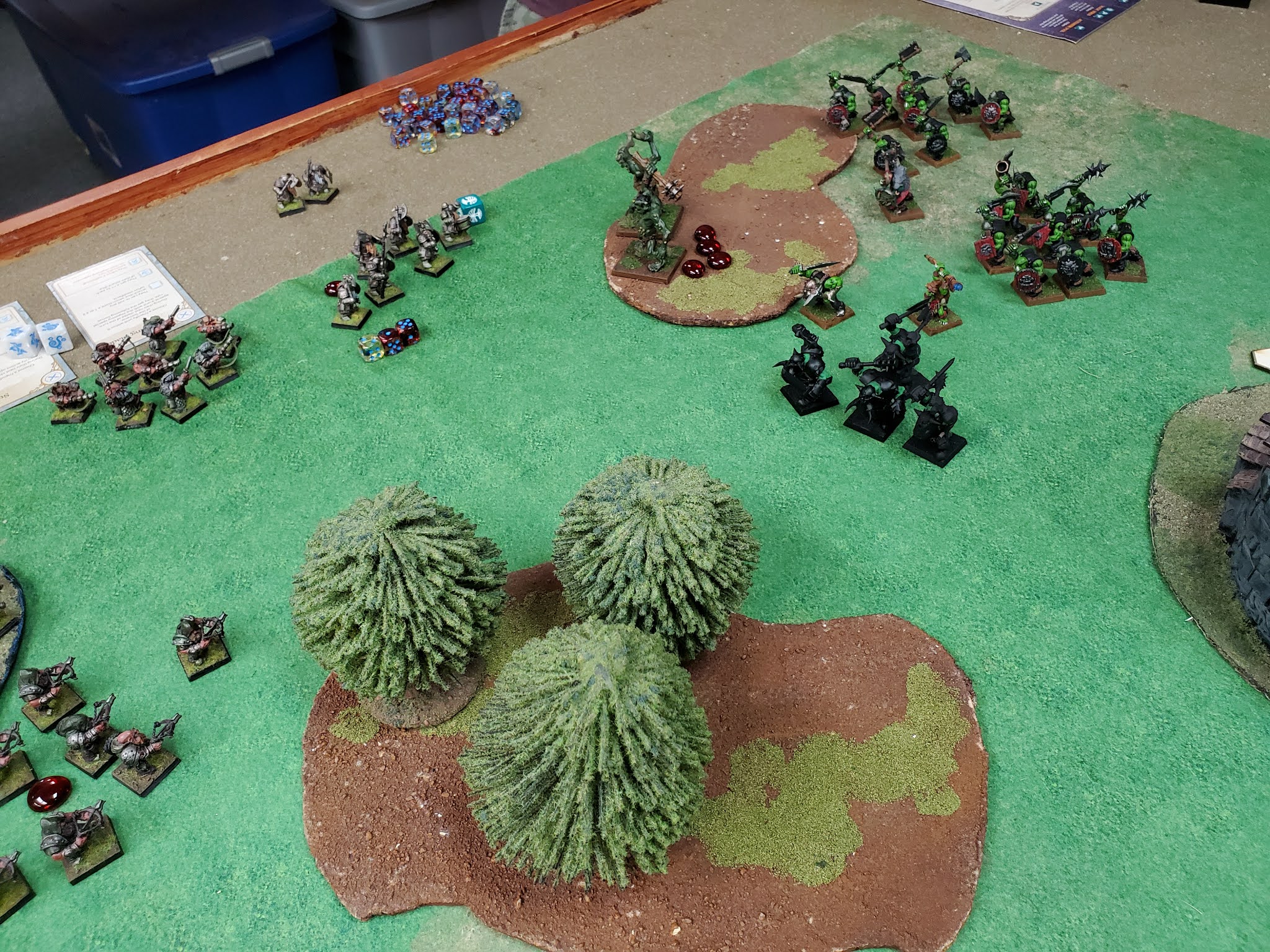
We decided to use the "Battle of Heroes" scenario from the Book of Battles to randomize the table and objectives. We were fighting in the Uplands, with two ruins, two pieces of rocky ground, and a woods in the middle. With the Confusion deployment, our warbands were diagonally opposed across the battlefield. The game length was Until Dusk (six turns), the special rule was A Dash of Nostalgia (Warlords generate two Saga dice), and the victory Condition was Subjugation (a straightforward counting of massacre points at the end of the game.

Josh had brought a Masters of the Underearth warband, using the Dwarves of the Silverheight legendary rules:
  • Warlord
  • Wizard
  • 8 Warriors
  • 8 Warriors
  • 8 Warriors with Heavy Weapons
  • 8 Warriors with Crossbows
  • 8 Warriors with Firearms
  • 2 Bipedal Creatures (Living Statues)
  • Static War Machine (Cannon)
I brought a Horde Warband, which seemed best suited to my Orcs & Goblins:
  • Warlord
  • Wizard
  • Lieutenant
  • 4 Hearthguard
  • 8 Warriors
  • 8 Warriors
  • 8 Mounted Warriors
  • 3 Bipedal Creatures (Trolls) 
  • War Chariot
The two warbands seemed well balanced against each other. The Horde battle board largely focuses on charging into combat, and increasing the number of attack dice thrown when charging. The Underearth battleboard has more table control, with abilities that can block or halt enemy units, improve ranged attacks, and use your numbers (either because there's more models in your warband, or you have better armor) against the enemy. 


With just three dice in the first turn (as per the Until Dusk scenario length), Josh managed to roll two rare dice results and used the Chasm ability to throw up an obstruction to my infantry, keeping them back for an entire turn. 


My cavalry moved out to the right, hoping to land some blows before the big infantry horde would arrive. 


In the second turn, Josh decided to throw his Warlord forward at the War Chariot instead of letting it get a charge off. Unfortunately, in order to do so the Warlord ended up going into the fight with three Fatigue. While the Chariot wasn't as good while defending, I just needed Josh to fail two defense die rolls to kill his Warlord early in the game. 

So with the Rage ability and some luck, the Warlord and Chariot ended up destroying each other. It was a trade I was willing to make (although my unlucky streak with Chariots continues!). 


Since the first turn Chasm had forced my Orcs into the rocky ground, I was trying to rush them as quickly forward as possible, while the Dwarves hit them with rifle, crossbow, and cannon fire. Luckily, the Horde has the Endurance ability, which is a reaction that gives a unit solid cover from shooting attacks. 


Annoyingly, my cavalry charge completely whiffed, with the Boar Riders bouncing off the well-armored Dawi warriors. The Dwarves followed up with a counter charge, leaving only two Boar Riders left. I had these remaining Mounted Warriors flee, rather then give them up as easy points for Josh. 


With my cavalry functionally gone, I bet everything on the remaining infantry units, who were still slogging forward towards Josh's defensive position in the ruins. By now both sides were starting to feel the loss of their Saga dice, especially since Josh had lost his 2-dice Warlord so early in the game. 

My Wizard managed to get a fantastic round of combat thanks to his Transformation spell, which turned him into a Beast-mounted Warlord. The transformed Wizard wiped out a unit of Dwarf warriors whose crossbows had riddled the Orc Hearthguard before they ever got a chance to get into combat. The Orc Lieutenant followed up and wiped out most of the other unit of ranged Warriors equipped with firearms. 

With that last turn, the game ended, and the two warbands retreated to lick their wounds and count the dead. Josh's Dwarves racked up an impressive tally, scoring 29 massacre points. The Orcs didn't do too badly either, scoring 25.5, which rounded up to 26. As the Dwarves didn't manage to pull ahead on points, the game ended up as a tie. 

As Mythic Americas adds to Warlords of Erehwon to provide flavor to a somewhat vanilla system, Age of Magic adds just enough to Saga to give it a very different on-the-table feel compared to its more historical counterparts without slowing it down. The six factions or archetypes have enough variety in their units and from their battleboard to feel distinct, and you could even have two warbands of the same archetype use radically different approaches. The larger warbands didn't feel slower, since single-model or 2-3 model units are common. And magic was pretty easy to use, especially since the Wizards themselves are fairly static (you don't have to worry about magic levels or equipment, and each wizards get to pick three spells from two different schools of magic, depending on their faction). 

A fun game that feels different enough from Warlords of Erehwon to deserve time on the table. 

Wednesday, July 7, 2021

Jungle Altar-cation - Mythic Americas AAR

I've been pushing the local group to play more Mythic Americas, which had languished in the Covid void since last year. Josh took me up on my battle challenge and so macuahuitls and tomahawks clashed in a skirmish set in the jungles of Mesoamerica. 


I set up a pretty standard table, with some contributions from Sam - like the massive ziggurat - who was watching alongside Bill as Josh and I played. 

The Balance of the Way (primary scenario) was "Build Altars to the Gods." To score victory points, warbands would need to spend a turn either building an altar in the opponent's half of the table, or knock down an altar that the enemy had built on their own side.  


My Everliving Aztecs had ten Order dice, and the warband consisted of:
  • Tlalocan High Priest
  • 2 units of Tlalocan-Bound Dead x10
  • Tlalocan-Bound Marauders x3
  • Jaguar Warriors x7
  • 2 units of Eagle Warriors x5
  • Spider Sisters x3
  • Ayar (Bound Monstrosity) 

Josh's Everchanging Tribal Nations also had ten Order dice, and had:
  • Sachem on War Eagle
  • Medicine Man
  • 2 units of Mohawk Warriors x5
  • 4 units of Seneca Archers x5
  • Wolves x5
  • War Eagles x3

Deployment was pretty simple - 6" from a table edge. The ziggurat divided the table and turned the game into two smaller conflicts: my living warriors and Ayar facing off against most of Josh's infantry on one side, and my undead against Josh's mythical units on the other. 


The game started with my Ayar getting absolutely hammered by Josh's ranged units. While it did end up chewing through a few Nations units, it was a harsh reminder that the Erehwon rules aren't vey friendly to Monstrosities!


While my undead horde rolled forward, my living warriors had to take a more cautious approach as they were under fire from Josh's archers. I also didn't know where the War Eagles and mounted Sachem was heading, since they could easily move 30" in a single turn. 


Josh decided to have the Eagles split off into two groups. The Sachem led his mount deep into my lines, hoping to quickly drop off an Altar somewhere I couldn't easily reach. The other group went straight into the morbid mess of the Ayar. Unfortunately, while their claws did some damage and stripped the monster of some of its cadaverous armor, the Eagles were wiped out in the process. 


Over the next couple turns, the battlefield was quickly emptying as units wiped each other out. The Ayar's "Stuck-In" special rule caught two Nations units, and the monstrosity killed the Medicine Man and a unit of archers before dying in turn. This let Josh reveal and score a victory point for his Devotion (secondary objective), Trophy Hunters. The coin in the picture showed where the Ayar fell, and Josh's units would need to stay near the trophy to score another point at the end of the game.

I then rushed up the useless Spider Sisters (since the Ayar was gone and the Sisters were only in my warband to increase the monstrosity's armor through spells) to the light cover on Josh's side of the table, as I had chosen it for my own Devotion, Consecrated Ground. Josh wasn't going to let such an easy target go, and massacred the Spider Sisters with a well-timed volley of tomahawks from his Mohawk Warriors.

In response, I charge the Mohawks with my unit of Jaguar Warriors, and after a fierce melee, only a couple of the Aztec knights were left standing. This let them score the Devotion on the next turn, scoring me a point.

Just out of sight, Josh had a unit of Seneca archers build an altar to score a point for the turn.
 

With the final turn of the game, Josh managed to sneak by and knock down one of my altars as my undead chased around the surviving Mohawk Warrior. 


I also used my Eagle Warriors to knock down an Altar, scoring another point. 


Unfortunately, a disastrously timed failed Order test kept Josh's Sachem from flying in and preventing him from scoring the bonus point for his Devotion, which left the Aztecs with 4 points against the Tribal Nations' 2. The gods of the Triple Alliance were pleased with the sacrifices!

Another fun game of Mythic Americas. There's still plenty we need to explore, like the scenarios, and Josh and I need to become more familiar with our chosen factions' strengths and weaknesses. 

However, it's great to get the game on the table. I think the Devotions of the Way and the Blessings of the Way (the single-use cards each players get) adds a great set of twists to the original Erehwon rules. 

It looks like Josh will be picking up the Inca when they come out, and I'll be waiting for the Maya to be released. 

Wednesday, June 30, 2021

Horseflesh for Dinner - Saga AAR

I recently met up with Josh for a game of Saga. Neither of us have had much experience with the new version, so we decided that a simple Clash of Warlords would do well to shake out the cobwebs and get a handle on the rules.


I brought out the Normans, with a Warlord, two units of six mounted Hearthguard, a unit of eight mounted Warriors, a unit of eight Warriors with crossbows, and a unit of eight Flemish Mercenaries. 

Josh brought his Jomsvikings, with the legendary Warlord Sigvaldi Strut-Haraldsson and five units of Hearthguard, two of which had great weapons. 

Sigvaldi ended up being fairly tough opponent. He had Resilience (2), which meant that he could take a point of fatigue to stop two uncancelled wounds. He gave his entire warband Armor 6 against shooting attacks. He could cancel advance melee Saga abilities with a dice roll against his Wrath tokens (which Josh largely forgot to use), and could remove the opponent choice of either allowing Saga abilities to happen or letting the Jomsvikings gain Wrath tokens. Yeesh.

The goal of Clash of Warlords is simple - play until one side cannot generate Saga dice anymore, then tally the dead. Whoever scored the most points was the winner. 


The game started with my mounted Hearthguard riding down a smaller unit of Jomsviking Hearthguard, who still managed to mangle my unit with their Great weapons. 

Josh pushed up hard through the village, forcing my mounted Warriors to flee after being savaged. Since I couldn't stop his Wrath generation thanks to Sigvaldi's Sly ability, the Jomsvikings Battle Board abilities hit harder. 


Unfortunately, my slow moving Flemish Mercenaries never got a chance to get into combat, and since they were mercenaries, didn't generate a Saga die for me to use. And while his warband has less models in it, each of those models were Hearthguard powered up by Wrath tokens. Josh used these to deadly effect, especially the ability that gave the Jomsvikings javelin shooting attacks, which my mounted and unshielded troops were especially weak to. 

It also didn't help that Sigvaldi's Resilience (2) meant that my Warlord couldn't seem to do enough damage to his Legendary opponent to deal the final blow. 


It was Sigvaldi that struck the final blow that brought down my Norman Warlord and ended the game. My unit of crossbow Warriors was too small to generate a Saga die, and the Flemish Mercenaries (which Josh had kited the whole game) couldn't contribute. 

With that, we crossed the fields of battle and counted the dead. Josh scored 26.5 massacre points, while I scored 23. It was a close battle, but the Jomsvikings could count it as a victory!

As I say in most other after action reports, I hope we play more. Josh is definitely interested, and picked up a box of Wargames Atlantic's Dark Age Irish to expand his warband options. 

Wednesday, June 23, 2021

Glory: 1861 - Rules Review

While reading the latest issue of Wargames, Soldiers & Strategy, I came across a review of a newly released set of rules for the American Civil War; Glory: 1861, written by Jon Sutherland and published by Caliver Books. 

Now, normally I'd gloss over something like that, as ACW rulesets are pretty ubiquitous in the wargaming scene, and I've already got Fire & Fury and Pickett's Charge as my go-to rulesets for my 10mm collection.

What caught my eye, however, was the subtitle for the rules: "Raising and Leading a Regiment to Glory."

Now that was interesting. From my experience, most ACW rules either focus on skirmishes or start with the regiment as the main tactical element and go up from there. Glory: 1861, however, uses companies as the tactical element, and does not feature any cavalry or artillery in the main rules.

Well, mostly. We'll get to that. 

So, that was my curiosity piqued. However, beyond the somewhat brief overview in WS&S, I couldn't find much chatter about the rules. No review, no forums, no Facebook groups, as far as I can tell (if there are any that you know of, let me know). So I decided to grab a copy for myself and review them. 

The rules start with an overview of the aim of the game; that is, commanding a regiment. It also has a brief historical section leading up to the war and the war's first year. There's a full Order-of-Battle for the First Battle of Bull Run, which is offered as a selection of regiments that players can use to base their regiment on. 

This section also lays out with what a typical regiment in the game looks like, and what other items you'll need to play - a handful of d10s and a half-dozen d6s, preferably three each of two different colors. There's also basing standards and the introduction of the "Regiment Card" which acts as your regiment's character sheet.

Players use Glory Points to make purchases for their regiments, and players start with 50 points to purchase their starting troops. 

Since a standard starting company of Inexperienced troops costs 4 points, and you'll need to spend 3 point to purchase your command figures (the regimental officers, the second and third officer, the two regimental banners, and a drummer). That leaves 7 points to spend on improving your regiment and its officers, and other bonuses. 

Each of your officers will gain a random trait, and your companies will also randomly roll for the quality of their troop and commanding officer. 

You can also spend points on bonuses. These can improve the stats of your officers, give additional training to your regiment, or purchases bonus cards that are randomly drawn at the start of each game. 

A small aside: Getting a least two of these cards (you get two cards per point spent) is worth it at your regiment's start. The cards are provided as copy-able sheets in the back of the book, and their affects range from simply improving your priority (more on that in a bit) to allowing additional moves in a turn to having off-table artillery support or a unit of dismounted cavalry showing up.  

A fun aspect is determining how long your regiment has signed up to serve. If your regiment's term is only three months, you'll have to test each of your companies to see if they disband after six games (as the game assumes your troops will see an average of two engagements per month). On a roll, you troops may stay with the regiment, or you'll see an influx of green troops. 


Games start with both sides rolling to determine their objectives and what their opponent's side of the table will look like. There are charts for both defenders and attackers, and if the scenario is more akin to a meeting engagement then both sides can roll on the attackers table. 

A game turn is taken in phases. Players roll a d6 and three Glory Dice, adding together the d6's result and any 6's on the Glory Dice. This determine their Priority level, which determines how many activations a regiment gets in a turn, and in what phases. A higher Priority gets you more activations in a turn, and if both sides are activating in the same phase, you roll off using your regimental officer's initiative plus a d6.

Companies have a variety of actions they can take during a turn, from firing to loading to moving into formations like line or skirmish. These actions may take multiple phases, so a company might spend the entire turn firing or freeloading, or quickly moving across the table. 


Combat is split between ranged fire and hand-to-hand fighting. 

Firing is done with d10s, one per firing base. The number of hits are cross-referenced against a chart that determines how many hits are kills and how many cause Terror, which will affect a units morale. 

Hand-to-hand fighting uses d6s instead, comparing the two sides' results against each other. 

Morale checks occur in certain circumstances, such as when a company comes under fire for the first time in a game, or a unit's Terror level is equal to or greater than the number of bases in the unit. A d10 is rolled with relevant bonuses or penalties. The results can range from a unit carrying on as normal, or routing and fleeing backwards (but not being removed from the table). 


As for my conclusion, well, I'm planning to put together two regiments with Old Glory's Blue Moon range of 18mm minis, as I already had some of these when I was trying to figure out what scale I wanted to play in (and ultimately ended up going with 10mm). With two minis to a base, it shouldn't be too difficult to paint up. 

The regimental commander and A, B, and C companies of my planned Union regiment

These are a clever set of rules that I don't believe has much competition in terms of other rulesets. I'm not sure how viable it would be for pick-up games, and it might be a little boring (and ahistorical) if you had the same two regiments going up against each other. I could see this being a fantastic game for clubs to play with a campaign, with each club member controlling a regiment and playing games, potentially with some club members also taking the roles of brigade and division commanders (maybe we'll see this in a future supplement alongside cavalry and artillery rules).

Check this rules out if you're an American Civil War enthusiast, or a wargamer who appreciates the application of role-playing elements to wargames. Hopefully we'll see a PDF of the rules which will make them more widely available. 

I'd like to get a chance to contact the author of the rules, as I'm looking for PDF copies of the Regiment Card and QRS. I've also got a couple questions about missing modifiers in the Morale section. 

If you've got any questions or thought of something I didn't cover, please leave a comment!

Addendum: Having now actually had a chance to play a game with the rules, I must note that there are more holes present than I am comfortable with. Multiple sections seem to be missing or forgotten. This is a shame, as it does affect my interest in the rules. Personally, I'm going to try and write out my own modified version that will hopefully fill in those holes, and tweak some of the various aspects of the rules that I wasn't satisfied with.